Showing posts with label frugal. Show all posts

Saturday, August 24, 2019

Read Yourself an Education FREE trial pdf now available!

I am excited to announce that I have released a free pdf version of the first semester of my new homeschool book, "Read Yourself an Education, Volume 1 - Around the World, Country by Country."

The full version is due to be released through Amazon later this fall. In the meantime, the pdf will allow you to get started using the book for the upcoming 2019/20 school year, if you so wish.

Get the pdf and sign up for the newsletter at www.readyourselfaneducation.com!


Tuesday, March 11, 2014

Update on "Zero Spending" March Challenge

A week and a half into my "spending zero in March" challenge, I must report things are going exceptionally well. If you remember, my only exceptions to the "zero spending" rule were:

milk, cream, cheese
produce
animal feed
essential toiletries
any medically indicated expenses
gas, vehicle repairs
To be honest, it has been so easy that I have hardly even noticed any difference yet. As far as groceries, dairy and produce is all I have bought so far this month: milk, some bananas and ginger from the store, plus my weekly produce co-op I organize. 

2 bunches of chard, 2 pink grapefruit, 10 Granny Smith apples (about 3 lbs), 1 bunch asparagus, 9 avocados, 3 heirloom tomatoes (about 1 1/4 lbs), 2 pints miniature heirloom tomatoes, 10 oranges (about 3 lbs),4 mangoes, about 4.5 lbs mild Hungarian peppers - all certified organic

Can you believe all that came to only $23/share?? The avocados were beautiful and just perfectly ripe. We had 4 of them with guacamole and homemade corn chips for an appetizer that night. The rest, I pureed, mixed with lemon juice, and froze to have on hand for whipping up guacamole in the future.

In other exciting produce news, the warehouse had sweet Hungarian peppers last week. This may not mean much to anyone but me, but this is a very, very rare treat, and even more so in organic. In all my years of living in the US, I have only found these Hungarian peppers less than a half dozen of times, and only for the second time in organic (peppers tend to be sprayed heavily, so it's definitely worth it). They made me equally homesick and happy. Nothing brings tears to the eyes of an expat like smelling Hungarian peppers! You think I'm kidding, but I'm not. 

 
Since my freezer stash of these peppers from last year was virtually gone, I sprang for an entire bushel of them, for an extra $17. John helped me wash, seed, core, and slice the peppers. In all, we ended up with 5 gallon-size freezer bags, plus left some fresh for eating right away. The kids kept snacking on them all morning while we were working with these.


In addition to getting a great deal on the produce basket, I scored a killer deal on some organic raspberries and blueberries by the case. I bought one of each, and the kids ate most of them (that's 12-6 oz clam shells of each) fresh, though I was able to get some of the raspberries in the freezer.

Plus, I have been gifted this week with homegrown turnips, carrots, beets, mustard greens, oranges, French baguettes (made by a real French person!), and extra raw milk and cream from a friend I don't ever even get our milk from. I have been busy making my own kefir, yogurt, sour cream, and quark from the extra milk. Later this week, I may try my hand at making fresh mozzarella - something I have been wanting to do for a while now.

In all, I have spent less than $140 so far this month on food, and neither our pantry, nor the fridges or freezers are even any leaner than they were last week, all while we have been eating just as well and as much as ever. At this rate, I will be able to keep this challenge going for a whole lot longer than a month - at least in the grocery category, which is our biggest expense each month.

Tonight, as I was putting in my (very minimal this time) order from Azure Standard for the aforementioned items that are excepted from this challenge, I learned that they started a program several months ago where they give their drop point managers a certain percentage of their drop point total in purchase credit. Talk about a pleasant surprise! Since I didn't know this credit had been building up for the last several months, I have enough to mostly, if not fully, cover whatever little I was going to order to keep me going until the May delivery.

My spending on things besides food has been minimal. I have gotten gas once, and also bought dog food. While I never recruited my husband to participate in this challenge, he has been mindful of how to help me with my goal of spending near-zero. For example, our kids typically participate in a weekly P.E. class for homeschooled kids. In March, there were only going to be 3 classes instead of the typical 4 because of spring break, and we missed one of those last week because of a different field trip we were going on. Not wanting to spend a full month's tuition for half as many classes as usual, we decided to skip the P.E. classes this month. Instead, he took all 7 kids on a bike ride this morning to make sure the kids still go their exercise, and I got my much-anticipated weekly break. Cost: free, and the kids had a blast.

God has really been blessing this challenge in exceptional and unlikely ways! If nothing else, it has been exciting and fun, but I am also very happy about the money we are saving. In addition, I am learning how to make some new things I have been wanting to try. For entertainment, we are pulling out crafts and projects that we already have in the house, or participating in free activities and field trips. My husband and I had an "at home" date night on Sunday night complete with a candlelit 3-course steak dinner.

It always cracks me up to see what blog posts of mine people will go all crazy over. Well, the March Challenge was definitely an unlikely candidate, but boy, did it draw some hateful comments! I guess saving money and using what one already has is a little-regarded skill these days. Some were suggesting my husband get a second job instead. Every economist will tell you that saving money is much, much more effective than earing more, because the latter always leads to people spending more, and having a bigger overhead in general. Others were accusing me of working too hard, when in reality I saved myself major time and trouble by hardly going to any stores all week. Making bread at home is a snap, and something I do all the time, not just this month. The kids are benefiting from the less-than-usual running around (on errands), and so is the house because I am here all day making sure boisterous little kids don't trash the place while I am at the store.

I am hoping to give you another update on this challenge in a week or so.


Honestly, it has been a great experience all around so far. There are definitely some changes I will keep incorporating even when this month is over, and I may keep the "eat your pantry" part going well beyond March since our stores are not even running any lower yet, at all.


Monday, March 3, 2014

An Interesting Challenge for March

Last Saturday, I was cleaning out, organizing, and taking inventory of our freezers. I had been meaning for some time to do a so-called "pantry challenge" - seeing how long I could go using almost exclusively foods I already have in my pantry, fridges, and freezers. 

Because we buy most all of our foods in bulk or by the case, we have more food in the house than the average family. Of course, we go through tons of food each month, but it's a revolving inventory that never gets depleted. 

I was inspired to do a "pantry challenge" partly because it would force me to use up random odds and ends that have accumulated over time, and partly because it can never hurt to save some money (even if it is more of a "cashing out" of our items in stock, rather than reducing our overall consumption). We would really like to pay off the medical bills that we are still making payments on before the cards they have been charged to start accruing interest. Thanks in no small part to the many who have so generously donated to our medical fund (honestly, thank you SO MUCH, we truly appreciate every single donation!), we have been able to knock out one bill after the other. Just this month, we were able to pay off one of the two remaining massive hospital bills. By reducing our spending this month, we could increase our financial wiggle room again, since it was pretty much wiped out by paying such a large sum at once. 

As I was thinking about this, it occurred to me that I would like to try and cut out just about ALL spending this month. There are no holidays, no birthdays, or other major events that would really suffer if I implemented a "zero spending" policy for myself. We are well stocked on food, and most basics like toiletries. Not spending any money on clothes, entertainment, hobbies, books, dining out, field trips, etc. will likely be painful at times, but we certainly don't NEED to have any of those things this month.

Later that same day, I was thrilled to find that one of my friends on Pinterest had just pinned something along these lines - what a wonderful resource to stumble across! Plus, it really validated my idea as something that was possible, and had successfully been done before by many others. 


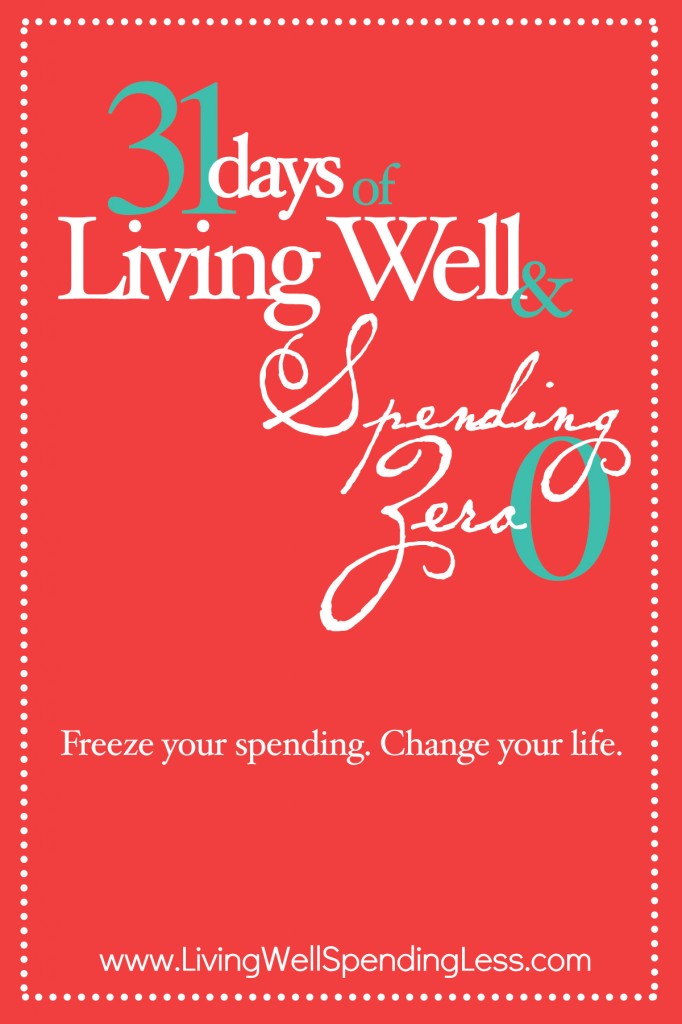
This no-spend challenge is called "31 Days of Living Well and Spending Zero," and is hosted on the popular "Living Well, Spending Less" web site.

I was so excited to find this just in time, and to get started right away! Saturday happened to be March 1st, so I jumped into Day 1, "The Ground Rules" Obviously, like most people, we have monthly bills for mortgage, utilities, etc. that we will still have to pay. In addition, there are other exceptions that everyone needs to decide for themselves what they will still need to spend money on.

Below are my ground rules, complete with exceptions:

~~~~~~~~ 

Grocery and other items I may buy this month:

- milk, cream, cheese (and possibly other essential dairy products): these are items that have a short shelf life, so we do not keep more than a week's worth in stock. Being pregnant and having lots of kids at home, I do not feel it would be beneficial to our health to cut these out for the remainder of the month once we run out. However, I should be able to make most of our dairy products like kefir and yogurt myself from the milk and cream. I will try to reduce spending even on these items by not buying more until what we currently have in stock has been used up completely. We have chickens for fresh eggs, and plenty of butter already in stock.

- produce: Like fresh dairy, this only keeps so long. Poor baby Stephen can't go for weeks without his daily allotment of bananas! However, I will again try to reduce spending on this category by using up the abundance of frozen and home-canned goods we have in stock, as well as taking advantage of any free produce that comes my way. Some of my friends share the abundance from their gardens with me, and free citrus is everywhere this time of year in Arizona. 

- animal feed: I only ever keep one month's worth of feed or less in stock, so we will need to buy some more before the month is over. 

- essential toiletries: while we do have a generous stock of most items, those that are bulky we keep in smaller quantities. I may still buy: TP, tissues, diapers (I would use cloth, but don't have any in Stephen's current size), wipes, laundry soap, and whatever other essential staple we may run out of.

- any medically indicated expenses: really, the only thing I could think of would be an unexpected doctor visit. We already have plenty of supplements and a well-stocked (natural) medicine cabinet.

- gas, vehicle repairs: We are down to one vehicle for our family, but to think we can go an entire month on what is left in my tank is not realistic. However, I will again try to reduce spending in this area. Not going shopping should help with that! :) Seeing as our van is still very new and under warranty, I don't expect there to be any repair expenses. I do need to take it for an oil change this month, but we still have a free one from the dealership left.

Things we have already committed to paying for this month:

Just our mortgage and regular monthly bills for utilities, phones, my insurance, etc.

Things I may absolutely NOT spend money on this month:

- groceries beside exceptions listed above

- toys, clothes, dining out, books, entertainment, hobbies, any household items or furniture, gifts, field trips (unless they are free), convenience items such as paper plates (ouch), etc.

- services such as hair cutting, car wash (not even the $5 self service we always use), etc.

- Pretty much anything not listed in the exceptions above

Unlike just doing a "pantry challenge," cutting all spending on the above actually WILL reduce our overall spending, as these are not items that will need to be replaced or made up for at a later time (unlike an empty fridge). Only three days into the month, and I have already turned down two books I really wanted, as well as a great clearance deal on some maternity items I would like, but definitely don't need. Tomorrow, we are going on a field trip (tickets for which were purchased last month, whew!), and I will be extra careful to pack a very generous sack lunch for us all, as we will not be buying food out if I don't bring enough.

Other Rules:

- This challenge applies only to me, not my husband. He is not a big spender anyway - I buy most everything we use in our home. 

- I will not send my husband to the store to have him shop for me "by proxy" to get around my zero-spending policy.

- I will track all spending through an app on my phone.

- In mid-March, I may order from Azure Standard whatever I will need for April 1-14. Their delivery in April is not coming until the 14th, so if I skip the March order and delivery, I would have to keep the challenge going for 6 weeks. I will limit myself to absolute must-haves that cannot wait until the delivery in mid-April. 

~~~~~~~~

These are just my ground rules - what works for me may not work for someone else. The idea is just to have a frame work of what is and is not allowed, when the temptation to buy something is strong.

The challenge for Day 2 was to organize my pantry. I had already organized the freezers the day before, and since my pantry gets organized every month when Azure delivers, that was all that was necessary. 

Today's goal was to come up with meal ideas. While our regular dinners won't need much tweaking (yet?), I figured since I am already on a "reduced spending" and "simplify life" kick, I need to tackle our breakfasts while I am at it. 

Typically, our family eats a cooked breakfast and a cooked dinner each day. Lunch is leftovers from the previous night's dinner (I always cook a double batch for dinner to make sure there are enough leftovers). As much as I love a good breakfast, they can be time-consuming and expensive. For the month of March, there are only two options available for breakfast each day: oatmeal, or eggs. Both are cheap and nutritious, and can be prepared in a variety of ways to mix things up a bit. I may make an exception on the weekends and make a special breakfast if there is time, but if there isn't, that's okay, too.

For lunch, to cut costs, I will only serve dinner leftovers from the night before if we had a relatively inexpensive meal, such as soup or a casserole. If, on the other hand, I served something that was very heavy on the meat side, I will only make enough for that night's dinner, and then serve one of the following simple, inexpensive, yet nutritious lunch options that can be prepared by one of the kids if I am short on time: sandwiches/wraps, salad, Mexican food bean burritos or quesadillas, etc. Again, there is much room for variety here. Some sandwich ideas are: PB&J, tuna, cheese (grilled or not), ham or turkey, egg, cucumber, etc. Since I am not buying bread, this means I will need to stay on top of baking bread each week from grain I already have in stock.

Soooo... three days down, 28 to go! Have you ever done a challenge like this? If so, do you have any advice or insight to share? If not - do you want to join me in this challenge for the rest of March???!? Please chime in below!


Sunday, March 24, 2013

Things I like to order on Azure Standard - Part 1

I first discovered Azure Standard almost 4 years ago. The first month, I ordered through a local drop point. By the second month, I had started my own drop point, and have had a monthly order and delivery for our group ever since.

About two years ago, my drop point had grown so large that I asked one of my members to split off and start her own group with the members that were closer to her. Now, it seems as if we are back to that point again where we need to split because we are outgrowing my driveway - this month's delivery for our group totaled 1700 lbs of organic, wholesome goodness to the tune of $3200.

I am not surprised how quickly shopping through Azure Standard is growing in popularity. For one, there is the convenience of grocery shopping online, anytime, in your nightgown if you wish, without distractions from the kids, with all the time necessary to compare prices and tweak the order to fit the budget. Score!

Then, the delivery - even though we take items off the end of the truck ourselves, and distribute them by last name in my driveway, that is still a lot faster and easier than dragging the kids through the store and putting items into a shopping cart. Especially for me, who has everything delivered to my front door!

Beyond that, the experience as a whole is much more social than grocery shopping ever will be: We see what others are ordering, share our experiences, split large bulk orders, and chat and catch up - all while the kids are happily playing together and the adults work the co-op.


The prices, of course, are what initially draw many to order from Azure. I like to say it's like an online Whole Foods as far as availability of items, with a smaller price tag.

What's the downside, you may wonder? As for my drop point, it's zero customer service! Drop point managers like myself are not recompensed in any way, shape or form (beyond the satisfaction of knowing that we are helping others eat better). So people who are only there to freeload, show up late and not help unload and distribute, or expect me to store and refrigerate their goods until they have a convenient time to pick them up as if I were a for-profit store, quickly get the boot from our group. My driveway is not some sort of budget Whole Foods - and I make that clear to those who think otherwise.

As it stands, I would say we spend about 50% of our grocery budget on Azure, about 30% locally on dairy, meat and produce, and about 20% at Trader Joe's and Whole Foods to round out the odds and ends I need throughout the month.

I have often been asked about what I like to order from Azure. Over the course of the next few weeks, I will blog here and there about my favorite products. Really, though, I have yet to order anything I don't love.

Stay tuned for part 2! :)


Sunday, December 23, 2012

Last Minute Christmas Gifts

Only 2 more days until Christmas! Which to moms of many means one thing: only 3 more days until it's time to get started on gifts for Christmas 2013! Yay! :)

If you were relying on the world ending this past Friday to get you out of gift shopping/making, and now find yourself short a present or two, here are some simple, quick, but super impressive gifts to whip up at the last minute. 


I used this Wilton cookie pan, a gift from my mother-in-law


I'm not a coffee drinker myself, but these tasted simply fabulous.


Who know that just three ingredients could combine into the most tempting treat ever? Here, packaged in little gift bags with peppermint bark, are the white and dark chocolate varieties. 


These are scented with just eucalyptus, but of course the sky is the limit with essential oils. The boys tested some with lavender and eucalyptus and were instantly hooked. 


Three of my four suggestions are food based... hmm... but who's counting, right? :)


Monday, November 5, 2012

Homemade Baby Wipes

You may read this and go - "Make my own baby wipes?? Forget about it!!!" 

And if that's you, I don't blame you. I know all too well how many things are pulling moms in all directions day in, day out. My goal is not to add to the never-ending list of your obligations. 


But before you completely dismiss the idea of making your own wipes, let me submit to you that making these wipes is easier, quicker, and healthier than buying wipes at the store.

Ready-made baby wipes contain many harmful chemicals, most notably questionable preservatives. Since the vast majority of body care products are absorbed through the skin, I try not to put anything on my skin I would not consider food-safe.


Monday, January 2, 2012

Affording Organic - Part I - PRIORITIES

This is a blog post I first started in October 2009. When I was almost done writing it, Blogger had a glitch and deleted the entire post without saving it! In June of 2010, I once again sat down and started writing this post, which I am finally finishing up now in honor of the new year. Maybe someone will make it their goal to switch their family to a more wholesome diet this year after reading this.


I think my great aversion to writing on this subject is due to the fact that there is no easy answer. I would love to give you tips on how to switch to eating 100% organic on your existing grocery budget, but for most people, that is simply not the case. Unless you are currently spending a fortune on eating out and buying processed foods and snacks/sweets/sodas, and are willing to stop all that cold-turkey and start making everything from scratch, you likely will need to increase the amount of money you spend on food if you want to switch to eating all organic. I think that most of my readers already cook many/most things from scratch, and live frugally in general. For these families, short of switching to eating rice and beans, eating organically will mean spending more money. That's the bad news.


Monday, January 4, 2010

Natural Foods Co-op

About six months ago, our family switched to buying 100% organic foods. I buy our produce through a local co-op, our range-fed meat from a rancher in a small town nearby, and our milk from a small organic dairy on the outskirts of the city. I make most of our dairy products myself from this pasture-fed, raw milk. I also make all of our bread products and baked goods myself from organic whole grains that I mill freshly.

For all other things, I used to shop at stores like Whole Foods and Trader Joe's, which can be pricey. Several months ago, I discovered Azure Standard, a natural foods co-op based in Oregon. They deliver to almost half of the states.


Their prices on many items, especially if purchased in bulk, are much less than what I would pay at health food stores in town, and many times even cheaper than conventional foods at a regular grocery store. You can either tag your order onto an already existing drop point, or set up your own drop point along one of their routes as long as the combined total from all people who order from your drop point is at least $550.

At first, my orders were delivered to a drop point nearby, but I have since started my own with about 8 other members so far. This makes it even easier for me because it is a lot less work than going grocery shopping all the time with five kids in tow. There are no financial benefits or commissions for being a drop point manager, but the added convenience is more than enough.

If you have been thinking about switching to organic foods and you live in the delivery area, you may wish to check out their website. (You will need to get a customer number in order to view their prices.)

Wednesday, December 30, 2009

Great recipe for granola

My sister-in-law sent me the following recipe, and I love it! The recipe is very easy and quick, it's much cheaper and fresher than store-bought granola, and it tastes DELICIOUS!

Put in a pretty container, this would also make a nice gift for a new mom, a busy friend, or anyone else that you would like to show some kindness.

1 box (6 cups) rolled oats - I used quick-cooking oats
1 cup chopped nuts - I used sliced almonds
1 cup ground wheat germ
1/2 teaspoon cinnamon
1/4 teaspoon salt
3/4 cup honey (or honey mixed with maple syrup)
1/3 cup oil, any kind - I used coconut oil
1 teaspoon vanilla
1 cup dried fruit, optional


Preheat the oven to 300 degrees. Combine the first 5 ingredients. Warm the honey, add the oil and vanilla. Drizzle the honey-oil over the dry ingredients and toss to coat. Spread the mixture onto 2 cookie sheets. Bake about 30 minutes until golden, stirring every 10 minutes.

When done, remove from oven and stir in dried fruit if used. As the granola cools, it will lose its stickiness and become crunchy.

Makes about 9 cups.

Wednesday, December 2, 2009

An inexpensive Christmas gift idea

If you have lots of little kids in the house, especially boys, you may like this gift idea. It is a book. A book on how to build practically anything from cardboard boxes:


Don't let the title deceive you, there is much more than castles and cars in this book. I can't even begin to list all the fun projects that it covers, but you can look inside of it on Amazon and check out the contents page. Some stuff is easy enough for a 2-year old to make, and some projects require the help of an older sibling or parent. Our boys have LOVED having this book from the library, and yes, they are getting a copy of it for Christmas.

In addition to buying the book for $11.07, there are a few other things that are handy to have on hand as your children will want to start making something from it immediately:

- cardboard boxes in all sizes - appliance stores usually give these out for free, but call around and ask, because not all do. We keep an assortment of sizes in stock year-round.

- box cutter - about $2 at the hardware store. Definitely for use BY ADULTS ONLY!!!

- big bottles of tempera paint - teaching stores usually carry these for $2/bottle. Tempera paint washes out of most fabrics, and it can be diluted with water if you are painting a large project and want to "stretch" your paint.

- mailing tape - the paper type used to seal packages is best, but the plastic will work, too, it's just a little harder to paint.

- cardboard tubes, milk jugs, pie tins, extra pieces of PVC pipe, blankets, and anything else that can be turned into something new.

For a total cost of less than $30, you can give a gift that will bring hours upon hours of constructive, cooperative fun. Sure, I could buy a video game for my son to play by himself and rot his brain, but why would I when instead he could be playing outside with his siblings and building something tangible. The real sacrifice with this gift is not that I throw down a bunch of money that my husband worked long and hard to earn, but that I will have to dedicate some of my time to help them build whatever it is they pick, rather than keeping up with the never-ending housework or taking a break.

I already shared a picture of the castle I built with the kids a few weeks ago, which they are still playing in (even though it's in a state of disrepair by now). Today, we made a behemoth of a "fireplace" out of three medium-sized appliance boxes. This project was not in the book, but I thought it was fitting anyway because it was just like all the stuff in there.


We have since added yellow and red tissue paper "flames", and I am thinking about a way to make them "light up". We also need to hang stockings this year, which is why the kids wanted a fireplace to begin with.

Enjoy your child(ren) today, they grow up too fast!

Tuesday, October 27, 2009

5-Minute Recipe for 100% Whole Wheat Bread


Makes 2-3 loaves. Recipe can easily be doubled or halved.

1 1/2 cups lukewarm water
1 1/2 cups lukewarm milk
1 1/2 tablespoons granulated yeast (1 1/2 packets)
1 tablespoon plus 1 teaspoon salt
1/2 cup honey
5 tablespoons neutral-flavored oil, plus more for greasing the pan
6 2/3 cups whole wheat flour (I use freshly milled hard white wheat)

Mix together the water, milk, salt, honey and oil. I use boiling water and milk from the fridge, which together with the oil and honey make just the right temperature for the yeast when all is mixed.

Add yeast and stir (don't worry too much about it all dissolving).

Add flour and mix in without kneading using a big spoon, food processor, or KitchenAid with dough hook (speed 2). You may need a little more flour - the dough should basically somewhat hold its shape and pull away from the bowl, but still be very moist and not dry at all. The secret to this dough is that it is very wet, which is why it will rise without kneading and also keep well in the fridge.

Cover (not airtight) and allow to rest at room temperature until the dough doubles.

The dough can be used immediately, but it is easier to handle when cold. Refrigerate in a lidded (not airtight) container. Dough can be stored in the fridge for up to five days. I keep mine in a 1 gallon plastic pitcher with lid (vented).

When you are ready to bake, wet your hands and tear off a piece of dough about the size of a cantaloupe. Quickly shape and place in greased bread pan. Cover and allow to rise until about doubled.

Preheat oven to 350 degrees. Place an oven-proof bowl with cold water on a rack in the oven below the rack that the bread pan will be on. Bake bread for about 50 minutes.

When bread is done, rub top immediately with a stick of butter, which will make the top very soft and easier to slice. Take out of pan and cool completely on a wire rack before cutting.

Alternatively, the equivalent of one loaf also makes about a dozen rolls, which I make by simply placing balls of dough in a greased muffin tin. You can do this the night before and let them rise in the fridge overnight, setting them out in the morning for only 15 minutes or so for the dough to warm up a little before baking. I bake them at 350 degrees for about 20 or 25 minutes - just going by the color of the rolls and not really timing them. Again, I rub a stick of butter on the top of them as soon as they come out of the oven and then put them on a cooling rack. This recipe also makes fantastic hot dog and hamburger buns.


The dough is suited for any sweet baked good that uses yeast dough, such as cinnamon rolls, although if you have it on hand you may want to replace the hard wheat with soft wheat (pastry flour). Do not use the pastry flour for making bread, though.

This recipe is NOT conducive to making pizza crust and french bread, because it contains milk and bakes up too soft.

I got this recipe from "Artisan Bread in 5 Minutes a Day". Most of the recipes in the book use white flour, BUT they just released their new book TODAY: "Healthy Bread in 5 Minutes a Day". I ordered a copy on Amazon and will let you all know how I like it - supposedly, it has many recipes that use 100% whole grains.

I calculated that using all organic ingredients, raw honey, and raw milk this recipe comes out to less than $1 per loaf, with very little time or effort expended. Right now I am experimenting with using other grains, and adding sprouted wheat berries.

If you find yourself baking all or most of your family's bread (as I have done consistently since discovering this recipe), you may want to invest in an electric slicer. I found several on craigslist for $10-$30. You will be able to use the slicer for cutting meats and cheeses as well, which can help save money by buying in bulk.
Please leave me a comment if you try this recipe and let me know how you like it.

Wednesday, July 1, 2009

Question and answer, part II

As promised, I wanted to answer some of the canning-related questions that came from this post.

Do you use a pressure canner or just a big stock pot for processing? I saw a pressure canner at Wal-Mart yesterday for about $70, but don't know if that's a good price or not.

There are two ways to can: pressure canning, and hot water canning. Pressure canning is used for low-acid foods such as vegetables (corn, beans), meats, etc. Some people do use pressure cookers as a pressure canner, but canning experts advise against that. I think what Wal-Mart sells is a pressure cooker that is also supposed to work as a pressure canner, but again, I guess there is a difference and it's technically not as safe to use. Because pressure canners are expensive, and I prefer frozen vegetables and meats to canned ones, I only ever do hot water canning (which is only suitable for high-acid foods such as fruits and tomatoes). Fruit jams, jellies, applesauce, canned tomatoes, fruit syrups, canned fruits etc. can all be made in a hot water bath. A pressure cooker could be used for hot water canning, but it is impractical (smaller batches) and unnecessary, so there really is no need to spend $70.

Oh and do you use white sugar, or can you use raw sugar? (Trying to think of health here haha).

This year, I only used white sugar for canning. In the past, I have used honey, as well as fruit juice concentrate for sweetening. There is a different kind of pectin available at the store that is made to be used with fruit juice concentrate (usually white grape or apple juice) or sugar substitute (like Splenda - don't even get me started on that). The package contains all the necessary explanations. It's really pretty much the same, except that you dump in the frozen concentrate instead of sugar. The jelly will not be nearly as sweet, but it does taste very nice. I like apricot jelly and berry jams very sweet, though, so I used regular sugar. I have never used raw sugar in place of the white, but I'm sure that would be perfectly fine.

P.S. How do I get my future wife to make delicious stuff like this??? :)

As with everything in life, you catch more flies with honey. But what on earth are you doing on my blog? And how did you like the apricot jelly?

~~~~~~~~~~~~~~~~~~~~~

Below are some questions on other topics that I have been asked recently. If I missed yours, I am sorry, it was not intentional. If you have any other questions for me, please feel free to leave it in the comments section, and I will answer it soon.

Let's start with this important question:

Is there ANYTHING you don't know?

For starters, I don't know the name of the person who asked this, since they chose to leave an anonymous comment. Secondly, yes, there are obviously many things that I know nothing about, and probably many other things that I THINK I know but actually am wrong on. But no, I don't think it takes a rocket scientist to figure out that a C-section rate of over 30% is extremely out of whack.

hi Zsuzsanna. I was wondering what your thoughts on infertility in general are. I know you are vocal about your opposition to IVF. What are your thoughts about IUI, Clomid, etc.? What about adoption? I am not being facetious, I am genuinely curious. (Rachel)

I think infertility is a terrible problem for women to have to suffer, and I honestly feel very bad for those affected by it. However, I also believe that God is the one who opens and closes the womb and gives women conception, as the Bible says so over and over again. If a couple is childless, it is because that is God's will at that time. I am quite certain that God does not need our artificial means of trying to speed along conception. Interestingly enough, the Bible mentions many women that were barren, but after they prayed and asked God (in the case of Isaac, for two decades), every single one of them went on to have children.

Since I have already explained my position on IVF, I will give you my thoughts on IUI and fertility drugs (such as the one you mentioned, Clomid). I don't think it would be sinful per se to use fertility drugs at a normal dosage, but I also would strongly advise against it. Just because something isn't wrong doesn't mean it is good for us. If women have ovulatory problems, the underlying cause should be rectified rather than supplying the body with artificial hormones that are nothing more than a crutch, and will only lead to the woman's body becoming more out of balance hormonally. There are many herbs and other natural approaches to regulate a woman's cycle and restore her health to where she can then conceive naturally. People have commented on here that they tried drugs and IUI unsuccessfully, then tried herbal remedies, and became pregnant shortly thereafter.

As for IUI, I really do not know much about the process, and don't want to speculate. To me it seems that God intended the creation of a new eternal soul to be between a husband and wife, not a doctor in a clinic. God doesn't need the doctor's help.

Many times, people who use artificial means of conception take the fact that they were successfully able to have a child as proof that God condoned of their actions, and even used modern medicine to carry out His will. But there are many instances where people sin (fornication, adultery), and a child is conceived. It doesn't make the actions of the adults involved any less sinful, but the child of course had no part in it and is just as loved by God as any other. God has created the laws of the universe, and among them is that when two people come together, they are likely to conceive. God doesn't just suspend that law every time somebody decides to mess around outside of marriage, but it doesn't mean that He condones their actions.


Do you use two diaper bags and just split the stuff up, or do you use a diaper bag for each kid? Or, did you never have this problem? Lol. Trying to figure out what would work the best.

I don't really use a diaper bag. There are always a couple of diapers and a pack of wipes in my purse, as well as in the stroller, and also in the van. Chances are, wherever I am at, there is always a diaper and wipes within my reach. If the kids need a snack while we are out, I either toss that in the purse, too, or just pack a bag with water bottles, fruit, and a dry snack (like pretzels or goldfish) for everyone. But that's rare because I try to run errands between mealtimes, and avoid feeding the kids in the car.

Have you ever read any of the children's books by Kate Seredy? She was a Hungarian author and several of her books are set in Hungary.

No, but thank you for the tip, I want to check into that. We are currently reading the Little House series for read aloud time with the kids.


Years ago, when my babies were nursing, I, like you, enjoyed feeding them during the night while they lay next to me in bed. It was very comfortable for both of us, and less sleep-disturbing than getting up to sit in a rocking chair. However, the SIDS campaign has made this a big issue, so my daughter, who has recently had a baby (my first grandbaby!) is terrified of keeping the baby in bed with her to nurse at night. The medical community has created such a scare about this, and I am undecided about how much to be worried about it. What are your thoughts on this?

SIDS is such a hot topic, and I certainly am no authority on it. I know that SIDS occurrences are much, much lower in countries where moms naturally take their babies to bed with them. And, as another reader already pointed out, if a baby dies from becoming entrapped or smothered it was not due to SIDS, but another (preventable) cause. I for one certainly think that having baby beside mom is safest for baby and easiest for mom, but there are many who would disagree. I never lose any sleep when I have a newborn, no matter how many times they wake up at night. Our babies never "sleep through the night" uninterrupted until they are fully weaned, but it never bothers me one bit because I can feed them while I sleep. The older kids have all grown up to be great sleepers.

There is also a lot of very interesting information on a relationship between SIDS and the flame-retardant chemicals used in producing mattresses. You can read more about that here. It seems that this could very well be the true cause behind the baby suddenly not breathing, and subsequently dying. It would also explain why having mom close by could be lifesaving, as she acts as the baby's "breathing pacemaker". Mom may also wake up if she subconsciously notices that something is not right with her baby. Please click here to read what I have written about SIDS in the past.

My wife and I have decided to switch traditional roles. Nobody forced us to and we didn't force each other. She works all day and I stay home with the kids and do the housework and cooking and such. I also do have a job which I do from home. Do you gave any thoughts on that?

Yes, I do. But I am only telling you my thoughts because you asked. Regardless of whether or not I think that something is a right choice, it's really none of my business to personally make sure that everybody does the right things in life. While I do blog about a lot of issues in general, I do so to inform people and maybe get them to look at their decisions in a different light. I almost never "rip" on a person specifically or point out the flaws I perceive in them. Not unless they are freaks like this woman.

Back to your question, my thoughts (in no particular order) are: your kids are better off at home than in anyone else's care; God intended for the mother to stay at home an raise the children and did not really leave it up to her personal preferences; I don't think there is anything wrong with men doing housework and cooking if that's what they want to do; glad you have a job you can do from home with your kids there; it's nice that you have such a close relationship with the kids; I would never do what you do but again, it infinitely better than putting the kids in daycare and both of you working outside the home.

Wednesday, April 29, 2009

Culture Pass

This is a program that anyone in the greater Phoenix area might be interested in:


You can check out their website to read all about it. Basically, anyone with a library card for one of the main libraries in the Valley can get 4 free admission tickets to one of 12 local attractions such as museums, zoo, botanical garden etc. for FREE. Only a limited number of tickets are available at each branch on any given day, and it's first come, first serve. I checked the libraries near my house for what was available before heading out the door to one of them. You can simply search for the keywords "culture pass".

This program is limited to one package of tickets per library card per week. Because of our family's size, I have to check out two of the same passes on separate cards, which is allowed.

This week, I am planning on taking the kids to the Children's Museum and the Heard Museum. Plus, I am trying to get tickets to take them to the zoo next week.

Even if you do not live in or around Phoenix, you should check to see if your city offers a similar program. When we lived in the Chicago area, all the major museums and attractions were free to residents on Mondays and Tuesdays. Also ask about homeschool days, which many places offer at drastically reduced admission prices.

Monday, August 11, 2008

Homemade learning games

I love stores that sell teaching supplies. I could spend hours browsing the merchandise on the shelves or leafing through their big, glossy catalogs. Other women go to the mall for fun, I ditch the kids with my husband and go to Lakeshore Learning Store. If someone would give me a $5,000 gift card to their store, I could spend it in one day with no trouble whatsoever. Not that it would ever happen, I am just trying to illustrate how I like all the things they sell there.

To be sure, I know that most of their stuff is completely unnecessary. I think it would not just be possible, but even beneficial to teach children with nothing more than a couple of books, a pad of writing paper, and a pencil. All the supplies, toys, games and gimmicks are fun to have, but certainly not necessary.

Anyway, because I like the toy factor but not the cost of what these stores have to offer, I made a couple of items that I really liked at home this week. It was easy, fun, and very inexpensive.

First I tried to recreate the "Alphabet Sounds Teaching Tubs", which retail for only $129. My kids love any and all miniatures. We already have a few from teaching games that I found at the thrift store or bought on sale, and they are very helpful in teaching kids to learn the letters, find rhyming objects, group items by color, or find things that go together (i.e. vehicles, food, etc.). So quite honestly, if I thought my husband would let me get by with it, I would have bought this set without giving it a second thought, even though I love to save money any other time.

Instead, I remembered that our local health food store carries clear plastic bins just like the ones in the Lakeshore set for customers who purchase fresh salads from the salad bar. The next time I was there, I packed up 26 little tubs and asked the cashier if they would consider selling them to me, but they said I could have as many as I wanted for free. At home, I pulled out letter stickers that I had bought in the scrapbooking section at the dollar tree, and labeled all the tubs. Over the next few days, I collected little toys and things I found laying around the house, and put them in the corresponding bins. I got many ideas for what to look for by looking at the Lakeshore catalog. Some of my tubs are still empty, and some don't have much in them, but I plan on sitting down one night this week and making a bunch of miniatures out of polymer clay (the stuff you bake in the oven). Since I already had all the supplies at home, my total cost for this project was $0.

I will be able to use many of the same miniatures in other games, such as the "Vowel Teaching Tubs", the "Blends and Digraphs Teaching Tubs", or the "Rhyming Sounds Teaching Tubs".

Here is a picture of the partially finished project:


The second item I really liked was the "What Rhymes? Game", which costs $39.95. Finding rhyming words is great for teaching kids about language and sounds, but the price is really not justifiable for me.

So I spent a couple of hours on the computer and designed my own game board by finding the right clipart in Microsoft Word. Then I printed everything, glued it onto cardboard, laminated it with clear contact paper, cut everything out, and finally glued the yellow ovals onto my gameboard (which is really two cardboard desk dividers taped together in the back and reinforced with some very heavy cardboard). A couple of ladies from church were at my house yesterday afternoon, and they actually did all the cutting for me - what a help! While my game pieces are made of paper rather than using cute miniatures, I am very happy with how they turned out. If I wanted to, I could replace these pieces with miniatures over time as I find/make them, but I don't think I'll bother. Here are two pictures of my version. The first one shows the game before sorting the rhyming objects, the second after they have been sorted. The real thing looks much better than you can see from the picture.


Again, I had all the supplies for this in the house, so my cost was $0 and I had a fun afternoon with friends from church. Just don't ask me how they enjoyed being volunteered for all the cutting... :)

By the way, Lakeshore's website includes the product guides with each of these item. This is the leaflet that usually comes in the package and gives teaching tips and ideas for games, as well as a complete list of contents.

There are still a few other games I would like to make my own versions of in the coming weeks. I have all the materials at home, so finding the time to make them is really my only problem.

Thursday, July 3, 2008

Meal planning

There are many benefits to planning your meals ahead of time. You don't have to come up with what to fix for dinner at the last minute when everyone is hungry and you are tired. You will be reminded to pull the meat for the next day's meal out of the freezer the night before because you already know what you will be cooking. There is less of a temptation to just go out to eat, which is less healthy, more expensive, and doesn't really save any time. You may reduce your prep time by working on the meal here and there throughout the day when you have a few spare minutes (i.e. grate cheese, chop vegetables, bake some bread on the side, etc.). You will be going to the grocery store with a shopping list, which makes the trip faster and reduces impulse buying of items that will then rot in the back of the fridge because you have too much food, or because you are lacking ingredients to complete a meal.

The downside is the planning it takes. As busy Moms, we tend to have "tired brains" and having to plan yet another aspect of our lives can seem overwhelming.

There are many resources available online and in books that offer ready menus, complete with shopping lists and all. Some are free, while others are not. Although these help reduce the planning required on your part, it is inevitable that your family will not like all the meals on these ready menus. Some are not healthy enough and use too many ready products, while other are so healthy that they serve salad for a full meal one night a week and a meat-free dish another night (my husband would not put up with either). Also, you don't want to stop cooking your family's favorite dishes completely.

After having tried many different of these ready plans, I have to say my favorite is a book called "Going bananas at mealtime". I found my copy at the thrift store but just found out that the publisher of this book is a Mormon company. It really has no bearing on the recipes, other than maybe proving that it is suitable for busy moms of many kids (Mormons don't believe in birth control). There certainly is no religious reference whatsoever in the book.

I like this book because it offers ready menu plans for breakfast and dinner for all 12 months of the year. I find that the recipes strike just the right balance between being healthy and tasteful, and almost all of them are enjoyed by us all. On the occasional nights that a meal we don't like is suggested, I can fall back one of of my own staple recipes. There are also ideas every week for snacks/desserts and special meals corresponding to the holidays that month. The ingredients for these items are not included in the shopping list, but can be added easily if you want to cook any of these suggested items. The back of the book also has a blank monthly menu form and a master shopping list that can be copied if you want to make your own menus. The breakfast suggestions are all easy and fast so you don't have to serve cold cereal every morning and can offer some variety instead.

Tuesday, July 1, 2008

Buying used curriculum

I purchased about 90% of next year's curriculum used, which saved me at least 60% off the list price. I thought I would share some tips about how and where to successfully find used text books.

- Oftentimes, older editions are fully compatible with newer editions. This is especially true for A Beka, who changes their book covers every couple of years without changing the content at all. If you do the research in advance, you can save money by buying older editions or combining older and newer books.

- As a rule of thumb, the most I would ever consider paying for used curriculum is half of the original list price (including shipping, since I get free shipping on my new purchases).

- In order to keep track of my purchases, I start by making a list of all the books I will need for the next school year for each child. I then check what books I already have on my shelf, and mark those off. Then I mark books I buy used off as I go, to avoid buying something twice or forgetting to buy a book. This year, it took me about one month (late May and June) to get everything on my list.

- I find that the best time to get good deals is in late May and early June, when much more books become available as moms get done with the school year, but buyers are still slow because they don't want to start thinking about the next year yet. July and August offer the greatest selection, but as demand increases the prices go up. During the school year the selection tends to be much smaller as moms are too busy home schooling to find the time to sell old curriculum.

- My favorite source for buying used curriculum is eBay. If you start early and are patient, you can get some great deals. Just don't get into the heat of bidding and pay more than you were willing to pay in the beginning. That same item might be available in a couple of days for a fraction of that same cost. I have been appalled by people getting so "worked up" at the end of an auction that they paid more for a used item than it would have cost new.

- HSLDA offers used curriculum on their website, and it is similar to eBay in that it is auction-style, with an option for immediate purchase at higher price. The selection is large, and the prices are lower than with eBay. The downside is that you have to be an HSLDA member to buy (but not to sell).

- You may get lucky and find something good on your local craigslist, but I have not had that experience. Seems to me that people are always asking way too much for text books on there. Just because something is "nearly new" doesn't mean I am willing to pay almost full price for it.

- A new website I just found but not yet used myself is Homeschoolclassifieds. They seem to have a large selection, and overhead is low because it's kind of like craigslist - the seller lists their own item, and you contact the seller directly via e-mail (rather than paying for all the bells and whistles that eBay offers).

- If you are looking for books from a major publisher such as BJU Press, you may find good deals in the used book section on Amazon. I bought all the kids' math books (from Harcourt Math, a secular publisher) at incredibly low prices there. Amazon is also a good source for buying educational books that are not part of your actual curriculum, such as for example a book of fun science experiments or a book on a particular subject your student is studying.

- If you live in a big city, you may have a store in town that sells used home school books. There is one here in Phoenix, and their used prices are pretty high - but they have 50% off days once every month. On these days, they also offer discounts of 10-15% off new curriculum orders.

- One way NOT to save money is by copying text book pages and having your student write on those copies rather than the actual worksheet. For one, these items are copyrighted and you are being dishonest. For another, you are probably not even really saving money because of the copying costs. If you would like to cut the cost of consumable textbooks, you could have your student write the answers in separate notebooks for each subject instead of writing into the workbooks directly. This usually works very well with older students.

For additional information, check out this helpful article I found online.

In the end, I think it would be possible to teach children almost entirely for free if you have a good education yourself and know how to use the internet and libraries. This is certainly the most time-consuming of all options, but your children's education will be just as good if you put the necessary effort into it. I am not talking about "unschooling" here, which I find is a terrible option and leads to kids who lack both a solid education as well as any good work habits and character traits such as perseverance, timeliness, etc.

Buying curriculum used is no doubt much more time-consuming and troublesome that buying new from the publisher. But I think it is so much more fun to get a great deal on something. As a stay-at-home Mom I also think it is my duty to use the extra time that I have by not having to work an outside job on finding ways to save money. A penny saved is worth a lot more than a penny earned because I don't have to give Uncle Sam half of it. So if you have been making excuses for wasting money on new books, or (worse yet) if you have been slagging on your kids' education and hiding behind the excuse that you can't afford the books you need, try one of the sources above for finding used books.


Wednesday, April 23, 2008

Improving your family's diet

One of the concerns on probably every mother's mind is making sure that her children eat healthy, nutritious food. But time constraints, cost, and picky eaters often get in the way of good intentions.

Here, I would like to share some of the changes I have made in our family's diet over the years in order to get everyone to eat healthier.

1. Read EVERY food label

This is probably the most important point. I literally read every food label before I buy a product, unless it's something I buy all the time and know to be "safe".

If a food contains any of the following, it will never make it into my cart:

- preservatives (about 90% of ready cereals on the shelf)
- hydrogenated fats
- high fructose corn syrup
- artificial colors and/or flavors

I also don't buy anything that has an extremely long ingredient list, even if none of them is "that bad". And I never buy anything that has ingredients coming from China.

Many of these items can be bought in an all-natural alternative if you check the shelf carefully. For example, all main-brand ready taco shells at my local grocery store either contain preservatives or use hydrogenated oil. The store brand ones contain only corn, corn oil, and salt. Not only are they cheaper, but they also taste better and are healthier.

If you can't find a healthy alternative at the grocery store, try a health food store instead. You will be surprised to find that the prices are not much different. For example, Hormel pepperoni at the store costs about $3 for a small package, but it contains preservatives. At my local health food store, the butcher makes his own all natural pepperoni without preservatives, nitrites, etc. It only keeps for a few days, but the same batch costs only about $1.50 and is enough to make two very large pizzas.

When you are first getting started you will need to invest some time into comparing prices and ingredients, but you will be a "pro" in no time. I know exactly what to get at which store now.

2. Try to include organic

Many people have the idea that if you can't buy all your food in organic, it's not worth buying any organic at all. Rather, you should go easy on your food budget and over time try to replace more and more conventional foods with organic. Of course, there will be times when the family's finances are tough and you may not be able to buy any organic, but you should not have an all-or-nothing attitude.

If you look around health food stores in your area, you may find that the organic produce on sale is actually cheaper than conventionally grown produce at the grocery store. You could also look into joining a food co-op in your area. Most health food stores also have bulk foods that cost less than the pre-packaged conventional alternative (e.g. quick oats, flours, raw sugar, dry beans, etc.).

The most expensive organic items are dairy and meats, so you may prefer to save money by cutting back on how much of these you eat. Personally, I buy all my meat at Sam's Club because the quality is excellent, the meat is all from the US (unlike Wal-Mart, who gets their meat from China), and the prices are great. I would eventually like to switch to organic meat, but for now this will have to do. Sam's Club and Costco also sell milk that is from cows not treated with growth hormones. Again, not organic, but better than what you get at the store for that price.

3. Serve 7 - 9 servings of fruits and vegetables per day

Conventional or organic, you should include lots of produce in your family's diet. In our family, the rule is to have one fruit and one vegetable with every meal. That's in addition to any vegetables that the dish may already contain.

I have found that divided trays with 3 or 4 compartments are a tremendous help to stick with this goal. You just don't feel right setting a tray in front of the kids that only has something in one of the four compartments. It is important to remember never to reheat food on plastic trays in the microwave, since this can break the plastic down and contaminate the food.

These extra servings of fruits and vegetables do not have to be another side dish that you have to cook. There are many quick fixes, such as: unsweetened apple sauce, sliced apples or pears, tangerine or orange slices, diced pineapple, strawberries, diced melon, baby carrots, radishes, cherry tomatoes, sliced bell pepper, etc.

Juice is not a good alternative to real fruit, and should not be viewed as such. One cup per day is plenty.

When your kids ask for a snack between meal time, offer them fruits. They may really enjoy dried fruit such as raisins, dried cherries, and banana chips.

4. Start early

This is another very important point. It is much easier to teach your child right habits from the start then to try and "deprive" them of all the junk once they are older.

Our kids have never had conventional cereals, except for when we go on vacation and I let them eat that stuff at the hotel for an event. To this day, they think that everyone eats plain Cheerios, hot cereal (cooked with milk instead of water), or something home cooked for breakfast. They don't feel deprived at all, in fact, they love those foods.

At meal time, I have to force the kids to eat some of the main course rather than just their fruits and vegetables. This would probably make every vegetarian's stomach turn, but my kids are all so skinny and I have to make sure they get some "real" substance.

Don't worry too much if your baby hates the jars of baby food. They ARE pretty disgusting. Rather, introduce him/her to soft, mashed fruits and vegetables from the table, such as bananas, avocado, pureed fruit, small pieces of melon, steamed carrots, mashed peas, etc.

If you have older kids and their palates are used to the junk, try replacing it over time with all-natural versions of the stuff they crave, while working on cutting some of it out.

5. Eliminate junk food out of your house

You could ease "food wars" with your children by not buying certain items in the first place, such as snack cakes, any ready bakery items such as cinnamon rolls, cookies, etc., ready cookies such as Oreos, Keebler, etc., any kind of soda - the list is endless (see point 1 above). If whining and begging at the store is an issue, you need to get to the root of it, which is a lack of discipline. Or you could leave them at home while you shop.

Instead of buying this stuff, you could make most of it yourself at home.

Examples:

- Instead of soda, try mixing equal parts of juice with carbonated water or unsweetened fruit or herb tea. My favorites are apple cherry juice with carbonated water, and apple juice with peppermint tea on ice.

- If you prefer the taste of pancake syrup to that of maple syrup (as I do), make your own at home from simple recipes that can be found on the internet. Tastes better, and has no preservatives or high fructose corn syrup in it.

- All desserts should be baked at home since there are almost none that can be considered healthy (Whole Foods carries some, but the prices are astronomical). If you must use white flour, you can at least switch to unbleached white flour. Personally, I love using whole wheat pastry flour, which (unlike regular whole wheat flour) is made from soft wheat and ground much finer. Your cakes and pastries will turn out light and fluffy and not have the overly nutty flavor that many whole wheat products have. If you have the money, you could invest in a high-end grain mill, such as the Nutrimill. After 8 years of marriage, I am still dreaming of that one.

6. Switch to whole grains

As I already mentioned above, you can make this switch pretty painless by using whole wheat pastry flour in all your baked goods. Baking your own bread is an excellent and healthy hobby, and your family will love you for it. It also saves a lot of money since a ready-bought healthy loaf costs about $3-4.

Replacing pasta and rice is pretty easy with the wide selection of products at the store. I like to use quick-cooking rice because regular brown rice takes about an hour or more to cook. If your family doesn't like the taste of a particular brand of whole wheat pasta, try a different brand until you find one they like.

Crackers and such can be found in whole grain alternatives at the health food store, often for about the same price.

If you live in a hot and/or humid climate, you should store your bread products and flours in the fridge to keep the bugs out of them.

7. Offer only healthy drinks

I serve the kids milk with every meal. If they get the milk at breakfast in their cereal, they can have one cup of juice. Between meals they can only drink water. Getting enough water is an important habit that you should teach your children now. We literally never buy soda (unless someone is sick and needs Sprite). If we go out to eat and the kids are mellow, I let them have one cup of soda, after which they can only get refills of water. If they are already wild, or it is close to bedtime, the last think I would dream about giving them is more sugar.

The only exception to this is some healthy soda from the health food store. Most of the stuff even from there is just a bunch of sugar water, but there are a couple of brands that are sweetened with only a little cane juice and made all naturally. Consequently, this is a very rare treat because a 4-pack sells for $4-6.

8. Cook from scratch

It saves money, it tastes better, and it's healthier. It's a way to show your family that they are worth your time and effort. It shows your love. "The way to a man's heart is through his stomach" is still true today. Do you want him to be in love with Stouffers, Banquet, Hungry Man, Chef Bonyarde, Ramen, or you?

9. Make changes gradually

Finally, don't overwhelm yourself or your family by going all natural overnight. Start with changes that seem the easiest, and add new changes over time. You don't have to tell anyone that the pasta in the dinner is actually whole wheat, or that you used a different flour to make the cake. Give their palates a chance to get adjusted.

At the same time, you ARE the parent and shouldn't tolerate a bratty or unthankful attitude toward wholesome food. If my kids ever complain about the food, I tell them that they may go out to the back alley and eat whatever they can find in the garbage can, just like many other children the world over have to. It gets them to stop griping really fast.

Over time, you will notice that you no longer want to drive through somewhere for lunch. Personally, I have not had any fast food whatsoever in years. In fact, you may find that you get sick to your stomach after eating there because you are used to eating better.

So do yourself and your family a favor, and start improving everyone's diet TODAY.